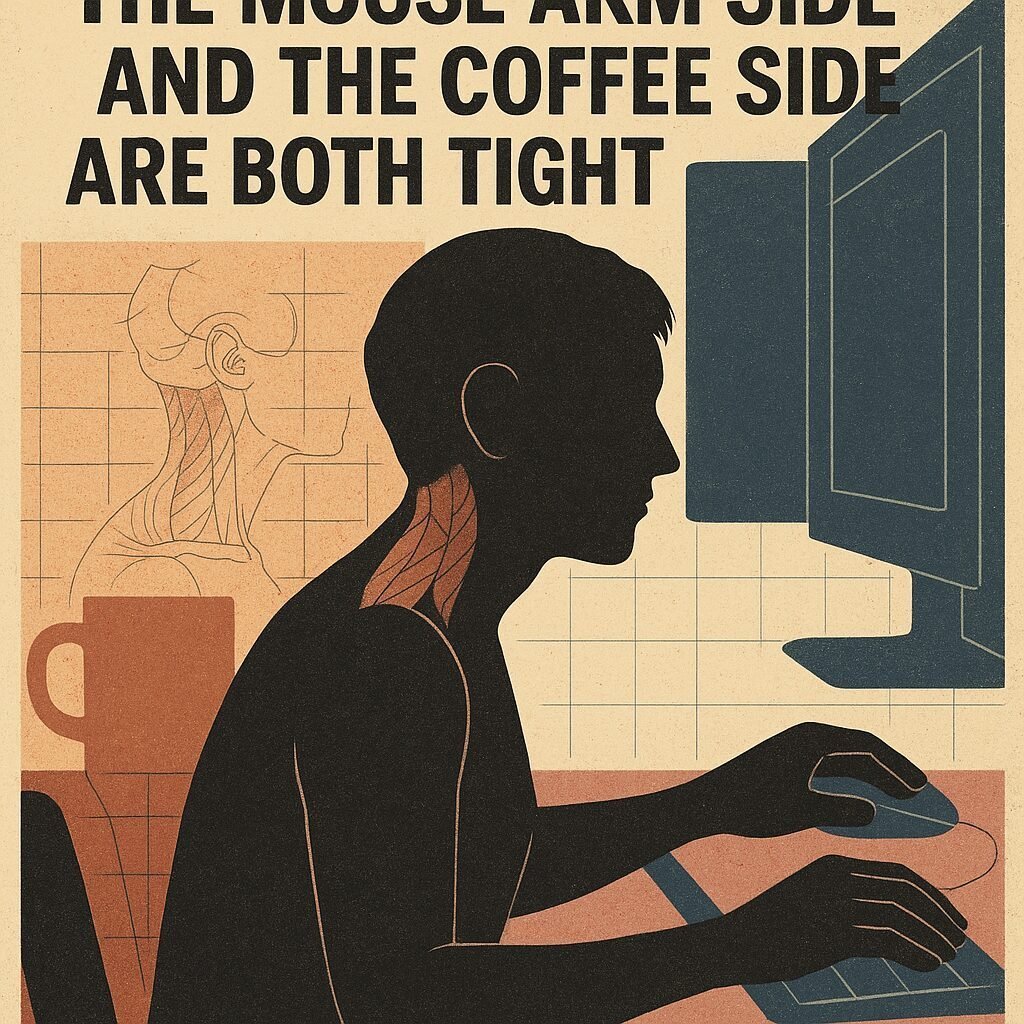
Pick a side of your neck. The mouse arm side. The other side. Both are tight, but in opposite ways.
The dominant side — the one closer to the mouse, the one you crane toward the second monitor — has muscles that have been on for years. Levator scapulae. Upper trapezius. Scalenes. They are tonic. They are short. They will not lengthen by stretching alone, because the brain has filed them under always working and stopped responding to elongation.
The other side has the opposite problem. Its muscles have not been asked to do anything. When the head tips toward the dominant shoulder, the opposite-side muscles should be lengthening eccentrically. They have forgotten how. So the head tips, but the asymmetry is real: one direction free, the other locked.
You feel this on the mat. In Marichyasana D, one side of the bind glides; the other feels like the head is bolted to the trunk. In Pasasana, the head cannot follow the rotation. The lateral flexion the practice quietly demands is asymmetrical from day one.
Equalize before chasing depth. Right hand over the head, drawing toward the right shoulder, opposite shoulder parked down. Hold thirty seconds. Press the head up into the hand at thirty percent effort. Release. Pull the head further into the lateral flexion using only the right side. Switch. The tight side gets two rounds. The sleepy side gets one. Full protocol here.