
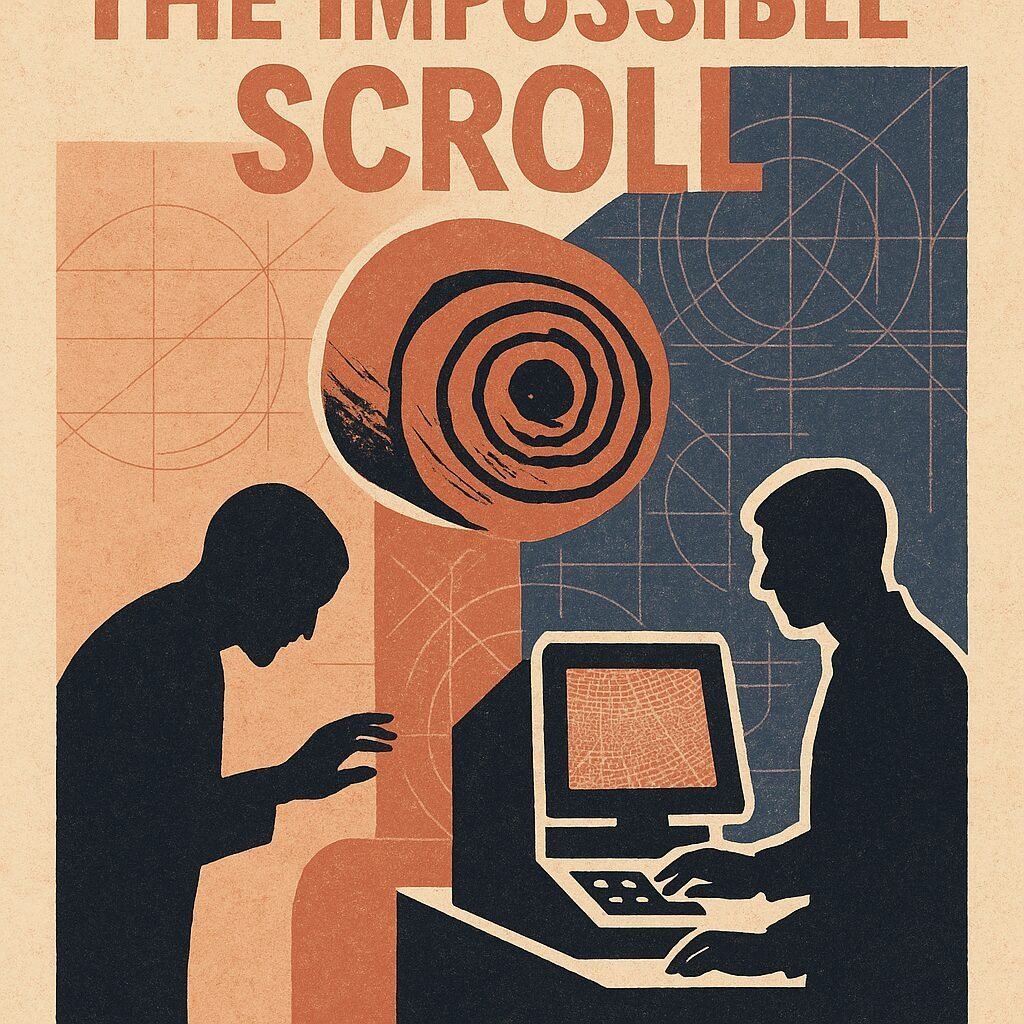
For two thousand years, the Herculaneum scrolls were unreadable. Carbonized by Vesuvius in 79 AD. Touch one and it crumbles. Unroll it and you destroy the only copy. So they sat there — full of text, completely sealed.
Then researchers stopped trying to force them open. High-resolution 3D scans and AI let them read the scrolls without unrolling a thing. They recovered a meter and a half of Stoic philosophy — likely Chrysippus — plus a book nobody knew existed. Source texts that had survived only as quotations in other people’s work. Now we can read the thing itself.
Your body is one of those scrolls. Most of it is carbonized — dense, resistant, illegible. The hip that won’t open. The shoulder that won’t track. You already know what happens when you force it: you get the crumbled scroll. Injury is just unrolling too fast.
Practice is the scan. Slow, repeated, non-destructive. The densest, most resistant places turn out to hold the most information — once you build the tool to read them. And repetition isn’t drudgery. It’s the training data. It’s how the nervous system finally reads what was, for years, completely illegible.
One more thing the scrolls teach: the source text is the body, not the commentary about it. Not what a teacher told you to feel. Not what the book said the pose should be. Read the actual scroll.
Read it: New Scientist on the Herculaneum scrolls
The technical version: Why your tightest spot gives the most →
— MJH